
Insights · October 17, 2026
SAT & Tax Guide for Foreign Property Owners in Puerto Vallarta (2027 Edition)
RFC or no RFC? See exactly how much SAT withholds from your Puerto Vallarta rental income — plus deductions and treaty credits that keep you from paying twice.

As a US or Canadian citizen owning income-generating real estate in Puerto Vallarta, navigating Mexican tax regulations often feels like a complex balancing act. Whether you operate a high-yield short-term vacation rental in the Romantic Zone or hold a long-term lease in Marina Vallarta, remaining compliant with Mexico’s tax authority — the Servicio de Administración Tributaria (SAT) — is essential to protect your asset and optimize your net returns.
This guide outlines the critical tax obligations, platform withholdings, and cross-border reporting mechanics every foreign property owner must understand in 2027.
1. Do Foreign Property Owners Have to Pay Taxes in Mexico?
Yes. Under Mexican Tax Law (Ley del Impuesto sobre la Renta), any income derived from real property located within Mexican territory is subject to taxation in Mexico, regardless of where the owner resides or where the payment is received.
When renting out a condo or villa in Puerto Vallarta, foreign owners typically operate under one of two legal structures:
- Non-resident individual (withholding mechanism): The owner registers for an RFC (Registro Federal de Contribuyentes) as a non-resident, allowing platform or property management withholdings to satisfy Mexican tax liabilities.
- Mexican entity or fideicomiso structure: Properties held through specific trust structures or Mexican corporations file regular tax declarations directly with the SAT.
2. Platform Digital Tax Withholdings (Airbnb, Vrbo & Booking.com)
Under Mexico’s digital economy tax legislation, digital booking platforms operating in Mexico are legally required to withhold taxes directly from payouts generated by short-term rental properties.
Standard Tax Rates Applied to Vacation Rentals
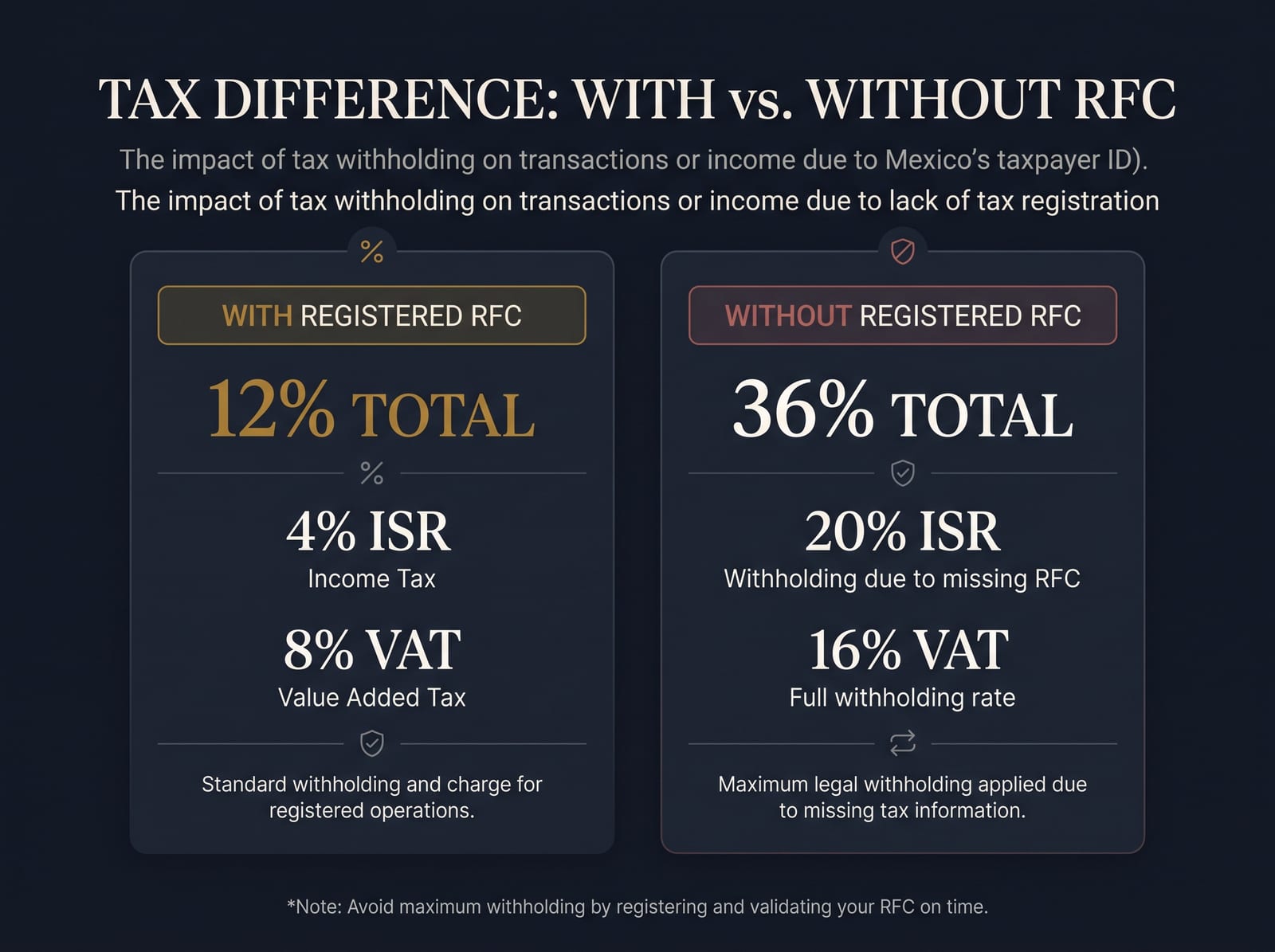
| Tax / Retention Type | Withheld with Valid RFC | Withheld Without RFC |
|---|---|---|
| ISR (Income Tax) | 4.0% (flat rate for STR) | 20.0% (gross revenue) |
| IVA (Value Added Tax) | 8.0% (retained by platform) | 16.0% (full rate retained) |
| Local Lodging Tax (ISH) | 3.0% – 5.0% (state dependent) | 3.0% – 5.0% (state dependent) |
Key takeaway: Failing to provide a valid RFC to digital platforms results in an immediate 36% combined withholding rate on your gross rental revenue. Securing proper tax registration reduces direct income tax withholdings to a manageable 4%.
3. Avoiding Double Taxation: The US & Canada Tax Treaties
A common concern among foreign investors is paying taxes twice on the same rental income. Fortunately, both the US-Mexico Income Tax Treaty and the Canada-Mexico Tax Convention contain provisions to prevent double taxation:
- Foreign Tax Credits (US IRS): US citizens can claim a Foreign Tax Credit (IRS Form 1116) for income taxes paid directly to the SAT, offsetting their US tax liability dollar-for-dollar up to applicable limits.
- Foreign Tax Credits (CRA Canada): Canadian residents filing with the Canada Revenue Agency (CRA) can declare taxes paid to the SAT on Form T2209 (Federal Foreign Tax Credits).
Always consult a cross-border CPA specialized in US/Canadian and Mexican real estate tax law to ensure accurate filings on both sides of the border.
4. Deductible Expenses for Property Owners
If you file formal monthly or quarterly returns through a Mexican tax representative or management agency, certain operational expenses incurred within Mexico can be deducted to lower your taxable base:
- Property management & hosting fees: Invoices (CFDIs) issued by authorized local management agencies like Praben.
- Maintenance & coastal repairs: Professional services for saltwater corrosion prevention, HVAC servicing, and plumbing.
- HOA fees & utilities: Condominium dues, SEAPAL water, and CFE electric bills issued with your RFC.
- Local property taxes (Predial): Annual municipal property tax payments.

5. The Praben Advantage: Seamless Financial Transparency
Navigating SAT compliance, RFC registration, and issuing official tax-compliant invoices (CFDIs) can easily create operational friction for non-resident owners.
At Praben Property Management, our all-in-one management model integrates transparent financial reporting with local tax coordination. We provide itemized, audit-ready income and expense summaries so you and your home-country accountant have complete visibility over your property’s net performance without the administrative burden.
Maximize Net ROI with Total Compliance
Stop letting tax confusion erode your investment yield. Let our team deliver a clear, data-driven financial breakdown for your Puerto Vallarta condo.